As companies grow, supply chain performance often declines instead of improving. Orders take longer to fulfill, inventory accuracy drops, teams rely on workarounds, and leadership struggles to get a clear, real-time view of operations.
This is a common and costly problem and it’s often misunderstood.
Supply chain performance doesn’t break because organizations scale.
It breaks because the systems supporting the supply chain fail to evolve with complexity.
In this article, we explore why supply chain performance deteriorates as companies grow, the structural causes behind it, and what organizations can do to scale operations without losing control, visibility, or efficiency.
How Growth Changes Supply Chain Dynamics
At smaller scales, supply chains can function with informal coordination:
- Manual tracking and spreadsheets
- Direct communication between teams
- Operational knowledge concentrated in a few individuals
This approach may work initially, but growth changes the rules.
As order volumes increase and supply chains expand across products, suppliers, locations, and customers, complexity grows exponentially. Dependencies multiply, decision-making slows, and small inefficiencies compound into systemic issues.
Without redesigning how the supply chain is supported digitally, performance naturally degrades.
The Real Reasons Supply Chain Performance Breaks
When performance declines, organizations often respond by hiring more people, adding tools, or increasing reporting. These actions rarely fix the root cause. The real issues are structural.
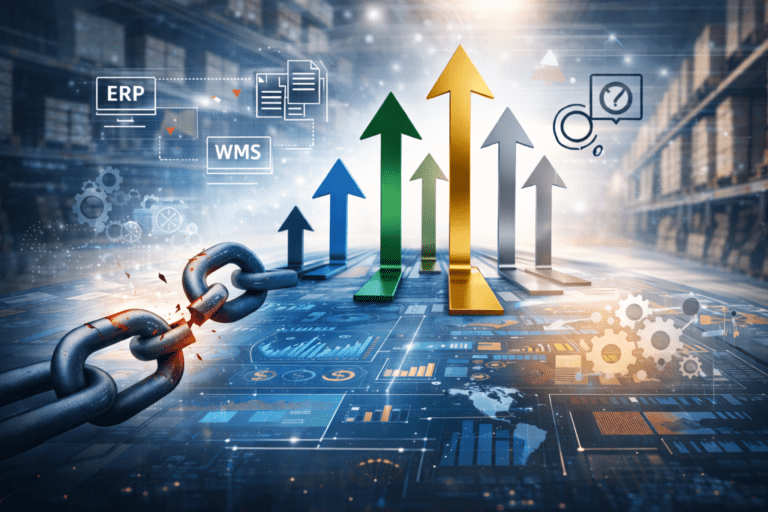
- Fragmented Supply Chain Systems: Procurement, inventory, logistics, and finance often operate on disconnected platforms. Data lives in silos, reconciliation becomes manual, and teams spend more time aligning information than executing decisions. Fragmentation erodes trust in data and slows response time.
- Manual Processes at Scale: Processes designed for low volume become bottlenecks as volume increases. Manual handoffs, approvals, and reconciliations introduce delays, errors, and operational risk. What was once manageable becomes unsustainable.
- Visibility Without Decision Support: Many organizations have dashboards, but few have decision-ready visibility. Reports show historical metrics, not real-time signals that help teams act quickly. Seeing data is not the same as being able to control outcomes.
- Systems Built Around Tools, Not Workflows: Off-the-shelf supply chain software often forces teams to adapt their processes to the tool. Over time, this creates workarounds, shadow systems, and inconsistent execution. When systems don’t reflect how work actually flows, performance suffers.
Why Scaling Exposes Weaknesses Instead of Creating Them
Growth does not create supply chain problems; it exposes existing design limitations.
At scale, high-performing supply chains require:
- Clear ownership of operational decisions
- Repeatable and standardized execution
- Embedded business logic in systems
- Real-time, cross-functional visibility
Without systems intentionally designed for these requirements, complexity overwhelms execution. As highlighted in McKinsey’s research on future-proofing supply chains, organizations that scale without redesigning their operational systems often see complexity outpace performance rather than improve it.
What High-Performing Supply Chains Do Differently
Organizations that maintain strong supply chain performance as they scale focus less on adding tools and more on designing connected operational systems.
They invest in:
- Integrated digital workflows across procurement, inventory, logistics, and finance
- Supply chain automation that reduces friction without removing flexibility
- Operational dashboards designed around decisions, not just KPIs
- AI-enabled insights for forecasting demand, identifying constraints, and managing risk
Most importantly, their systems are built to support how operations actually work, not how generic software assumes they should work.
Scaling Supply Chain Performance Without Breaking It
Sustainable supply chain performance is not achieved by speed alone. It requires clarity, structure, and alignment across systems and teams.
When supply chain systems evolve with growth:
- Teams regain operational control
- Decision-making becomes faster and more reliable
- Leadership gains confidence in performance data
- Complexity becomes manageable instead of disruptive
Supply chains shift from reactive execution engines to strategic assets.
Performance Breaks When Systems Stay Static
In conclusion, supply chain performance doesn’t break because company’s scale. It breaks when systems remain static while complexity increases.
Organizations that recognize this early and design their supply chain systems around workflows, automation, and decision-making are far better positioned to grow without sacrificing reliability or control.
At Innovantech, we help organizations design and build custom, workflow-aligned supply chain systems that integrate automation, analytics, and AI enabling operations to scale with clarity and confidence.
If your supply chain performance is being challenged by growth, it may be time to rethink how your systems are designed.
📩 Let’s start a conversation.