Most supply chain challenges don’t start with execution failures.
They start with systems that don’t reflect how operations actually work.
Many organizations today have invested heavily in supply chain technology. Procurement platforms, inventory systems, logistics tools, and finance applications are all in place. Yet despite this, teams continue to face delays, exceptions, manual workarounds, and limited visibility across the supply chain.
The issue is rarely the lack of systems.
It is the lack of connection between them.
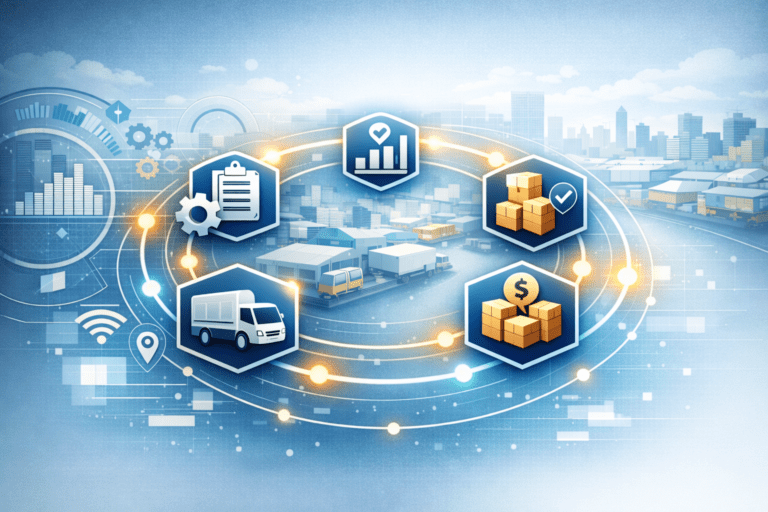
True supply chain improvement requires more than adding tools or automating isolated tasks. It requires a Connected Operations Flow, where systems are aligned to real workflows and information moves seamlessly across procurement, inventory, logistics, and finance.
Why Disconnected Systems Weaken Supply Chain Performance
As supply chains grow in scale and complexity, disconnected systems introduce friction. Data is captured in one place but needed in another. Decisions are made without full context. Ownership becomes unclear at handoffs between teams. This challenge is widely recognized by supply chain thought leaders. As highlighted in an article published by Anaplan, drawing on research and perspectives from Lora Cecere, founder of Supply Chain Insights, many organizations struggle not because they lack planning tools, but because their systems and operating models have not evolved alongside growing supply chain complexity. Common symptoms of disconnected supply chain systems include:
- Delayed approvals and slow response to change
- Mismatched records between operational and financial systems
- Limited end-to-end visibility into inventory, orders, and costs
- Heavy reliance on manual coordination to keep operations moving
Over time, these gaps force teams to create external workarounds just to execute daily operations. This increases risk, reduces consistency, and makes the supply chain harder to scale.
What Connected Operations Flow Means for the Supply Chain
A Connected Operations Flow is not a single system or a software upgrade. It is an operating model where supply chain systems are designed around how work actually flows across the organization. In a connected supply chain:
- Procurement decisions are informed by real inventory levels and demand signals
- Inventory movements automatically update planning and financial visibility
- Logistics events trigger timely actions across customer service and finance
- Financial data reflects operational reality, not delayed reconciliation
Instead of treating each function as a separate department, the supply chain operates as one continuous flow of decisions and actions.
Fixing the Most Common Supply Chain Breakdown: Handoffs
The biggest supply chain failures often occur at handoffs:
- When procurement issues a purchase order, but inventory planning is not updated accurately
- When goods are received, but discrepancies are not captured clearly
- When logistics completes delivery, but invoicing is delayed due to missing confirmation
These are not people problems.
They are system design problems.
A connected operations flow ensures that handoffs are designed so:
- Teams don’t need to chase information
- Systems don’t require repeated manual entry
- Exceptions are identified early, not discovered downstream
This is where supply chain reliability improves significantly.
Where Automation Fits in Supply Chain Operations
Automation plays an important role in supply chain improvement but only when systems are aligned first. When workflows are clear and data is connected, automation can:
- Reduce manual approvals and repetitive tasks
- Route exceptions to the right owners automatically
- Support faster, more consistent decision-making
- Improve responsiveness without losing control
Automation should not be applied to fix broken workflows.
It should be used to strengthen well-designed supply chain systems.
How Innovantech Supports Supply Chain Improvement
At Innovantech, we help organizations improve supply chain performance by designing systems around real operational workflows. Our focus is on creating connected operations across procurement, inventory, logistics, and finance, so the supply chain can scale without increasing complexity. We work closely with leadership and operations teams to:
- Understand how supply chain decisions are actually made
- Identify gaps between systems and workflows
- Design connected, workflow-aligned solutions
- Enable automation that supports control, visibility, and growth
We don’t start with technology.
We start with how your supply chain operates.
Conclusion: Supply Chain Success Comes from Flow
Sustainable supply chain improvement is not achieved by adding more tools. It comes from connecting systems in a way that reflects real operational flow.
When systems are aligned to workflows, data moves naturally, decisions become repeatable, and automation delivers real value.
A connected supply chain is not just faster, it is more resilient, predictable, and scalable.
If you’re exploring how to strengthen your supply chain through connected operations, Innovantech is ready to support that journey.